
“Oblique Strategies, mid twentieth century literature, bourbon”: Part 2
LB note: AK is occasionally asked by bigger and much more impressive studios to do narrative consultation. He turned down one gig a couple of years back when he was very definite that his skills were too small-scale and specialised to be useful on the big-budget game in question. But he likes the studio so he answered a round of questions gratis anyway. We came across the document recently and thought it seemed a shame to waste the answers.
We’ve removed any comments or information that could be used to identify the team in question, but for context we’ve played their games and like ’em! Here’s the second part of his Q&A – the first is here.

What is the best example of combining narrative and game mechanics? How to find a balance between storytelling and mechanics?
This is just too large a question to answer, especially when I’m already four questions past the two that I promised! I will possibly finish my next book, on exactly this topic, some time around 2027 when Lottie and I are done with the new game. 🙂 But I talk about poetic design here and here. This is also peripherally relevant, and one of my better pieces. See also my 2016 AdventureX talk and 2019 GDC talk (the second is more developed and probably better). Finally, the first half of this blog post outlines how I’ve been working more recently.
Once again, I understand that if you’re [REDACTED] and/or combat is a primary and irreducible system, this isn’t very helpful, sorry! But you asked.
Can you share an example of a narrative element that didn’t work out and what you learned from the experience?
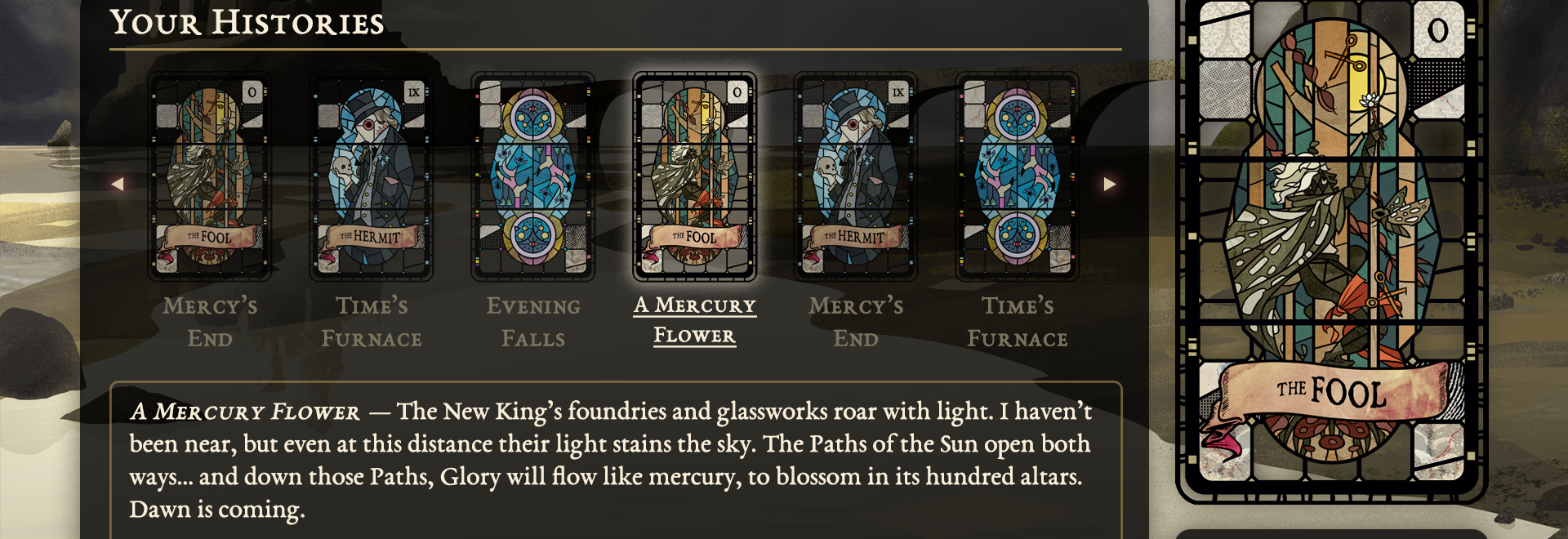
A recent example. I wrote a hundred and two endings for BOOK OF HOURS, although I expressly intended each player to finish the game once, and didn’t design it to have replay value. Partly this was the outcome of a combinatorial explosion effect in an early phase of the design that I hadn’t kept under control, partly just exuberance, but above all I wanted players to feel like they had chosen a specific path through the game that was theirs – of course they would share it with 1% of players but that meant 99% of other players would have a different outcome.
In hindsight it was an embarrassingly naive idea. Players enjoyed the ambience of Hush House, and many who completed the game immediately began another run. Few players felt that the ending was ‘their’ ending – it was the result of too many incidental events along the way and was insufficiently intentional. I had a fairly elegant way of recombining repeated elements into different endings that I thought gave the sense of different ending cards for choice variables, but it often just made players feel like I had reused or cannibalised events. Worst of all, the road-not-taken effect of so many different endings meant that players felt they were losing out if they stopped at one. We had a minimal achievements spread that meant you could get all ending-related cheevos without anything like all the endings, but of course this wasn’t visible to players. ‘Curse of knowledge’.
[Addendum – G.S writes:
“In my first playthrough of BoH, I achieved “Magnate Victory: The Whitest Flower”, and I totally thought of it as my victory. It was the most me-ist victory ever. So when you went on to say that the ending “was the result of too many incidental events along the way and was insufficiently intentional”, I was surprised again. I remember agonising over my initial Principle choice for many, many minutes – and thus I was happy for the outcome of that process to define the me I was to be, and thus also the endings that were most mine.
So not a total failure!]
I think satisfying endings in choice driven narrative games are a genuinely hard and interesting problem. I think the [REDACTED] and, IIRC, [REDACTED] approach of a post-ending dynamic slideshow is a really good and satisfactory one for larger projects, but I am very interested in iterating on the approach further in Travelling. The House of Light DLC endings for BOOK were a first step in this direction (and were much more popular with players).
Can you talk about a game you believe excels in narrative design and explain why it stands out?
What type of flavor texts (descriptions, notes & diaries, codex, etc.) do you find works best for player immersion?
‘I reject the dichotomy.’ An intuition pump: we don’t talk about ‘flavour art’. We talk about art. The question ‘what types of flavour art do you find work best for player immersion’ would be incoherent. Every word is an opportunity to create an emotional or aesthetic response. Every word that isn’t applied to that end is a missed opportunity.
Obviously there are limits. When I was writing Cultist and I wanted to talk about how much aspect was required in a recipe, I would say (e.g.) ‘twelfth-degree Lantern’ not ‘Lantern 12’. But there was one occasion in Book where I had to add e.g. [Spices & Savours 12] in diegetic dialogue. Still where mechanics are connected to the theme again (when I was still giving talks, this was my favourite topic) the mechanics can be explicitly used to create a parallel aesthetic and emotional response.
You can’t be too playful when you want to say GAME SAVED, and still less when you want to say SAVE CORRUPTED. But even in metatext there is thematic opportunity! The Fallen London ‘dying star’ error page and the Cultist/Book ‘cat sad’ error screen are both beloved. (There is also of course the legendarily playful Quantic Dream game menu, but they’re braver than me!)
Cultist uses Principle icons throughout its UI to start teaching the correspondences and establishing the mindset for players. This is something I get obsessive about and much instructive or semi-meta text that players see repeated will be repeatedly redrafted before launch.
Again I understand that this is unlikely to be practical in a traditional, AA(A) scale [REDACTED]: audience may focus on game mechanics and regard text as ‘fluff’, localisation becomes much harder, teams of writers have quotas to meet when filling in the gaps. Once again, sorry!
What is your opinion about the “show, don’t tell” incentive?
Heuristics are useful when they’re simple and reasonably reliable. That simplicity and reliability is also their limitation. Jerry Fodor (Psychosemantics) talks about heuristics (‘kludges’) in these terms: male sticklebacks use a simple heuristic for protecting territory, in that they attack anything red they see. This works because generally the only red thing that will ever enter a male stickleback’s field of vision is the dorsal fin of another male stickleback. Fodor adds however that a male stickleback would also attack Santa, if Santa entered his field of view. The heuristic maintains its effectiveness because Santa and sticklebacks are so rarely colocated. Male sticklebacks believe (in Fodor’s model) that colour indicates danger, and in the right context they’re correct.
‘Show not tell’ is a reminder that art isn’t a means of conveying information. In Wilson-Sperber terms it’s an opportunity for contextual effect. Or Wilde, Dorian Gray: “We can forgive a man for making a useful thing as long as he does not admire it. The only excuse for making a useless thing is that one admires it intensely. All art is quite useless.” If games were useful, they wouldn’t be called games!
Or to phrase it in the terms in which I answered the last question: everything in the game is an opportunity to create an emotional or aesthetic response. If we ‘tell’ rather than ‘show’ then we are generally sacrificing an opportunity to create that response. On the other hand, if there is something that needs to be said clearly and we fail to say it clearly, that’s a bigger problem. The art is I think partly in knowing the difference, but mostly (again see my last answer) in being able to multiplex those two modes together effectively. It’s never purely either show or tell.


“art isn’t a means of conveying information”
This is probably the stickiest trap of practiced fiction. At least, it seemed that way to me when I was going to school and taking writing classes. There’s something to be said about using every word, or every beat, to create a cohesive experience or develop a theme. But life is fairly bizarre and colorful, and if you make every line, for example, a beautifully crafted allegory for your strained relationship with your mother, it can become surprisingly monotonous even if your line-writing is beautiful.
Brennan Lee Mulligan has a really fantastic bit about this on an episode of Adventuring Academy with Oscar Montoya. It’s a bit off topic but one of the lines I found most interesting was: ” ‘Grounded’ is a poor man’s ‘Truthful’.” That has nothing to do with game development per se, but it does get into performance and what happens when you feed the aesthetic compulsion to make it all ‘fit’ a little too much.
I think that’s because there’s a difference between information in the general sense, and “information” in the game context, which would probably be more accurately, albeit incompletely, rendered as “direction.” My own inference, nothing Mr. Kennedy has said, and he does such a job blurring the lines between the two!