
“Oblique Strategies, mid twentieth century literature, bourbon”: Part 1
LB note: AK is occasionally asked by bigger and much more impressive studios to do narrative consultation. He turned down one gig a couple of years back when he was very definite that his skills were too small-scale and specialised to be useful on the big-budget game in question. But he likes the studio so he answered a round of questions gratis anyway. We came across the document recently and thought it seemed a shame to waste the answers.
We’ve removed any comments or information that could be used to identify the team in question, but for context we’ve played their games and like them! Here’s the first part of his Q&A – it’s a rich ragu, so here’s the second, separate part.

What are your techniques for introducing players to complex lore and settings without overwhelming or alienating them?
If lore and setting overwhelm or alienate people, they are counterproductive and shouldn’t be in the game. They exist to suggest a larger world; to excite curiosity; to prove a thematic or aesthetic substructure. It’s not history or non-fiction, so we don’t need to educate people. If it’s not innately interesting it shouldn’t be in the game. Unfortunately, en masse, we’ve lost sight of that and often regard ‘worldbuilding’ as an end in itself rather than one tool in creating an experience. We are seeing a reversal in this consensus but it’ll take 10-20 years to play out and I’ll probably be retired by then.
I understand that this is an unhelpful point of view for a team which [REDACTED]!I don’t see how you could have taken my approach with [REDACTED… REDACTED].
That said I just remembered that I did write about it back in the day – the piece is in my first game design book, or online here.
I am also having to address this to some extent in Travelling at Night, because it’s the third or fourth game in the setting, so I am prototyping some experimental approaches, but it’s too inchoate to discuss meaningfully.
What structure or template do you use when creating your characters?
Establish an emotional response that they’re intended to provoke; have a clear concept with at least one contradiction to keep the player off balance and ensure different opinions in the player base. Honestly though this is post facto, I usually just ‘have an idea and elaborate.’
For any major character I try to write at least one letter or setting document in the character’s voice (which will not usually be published – this is a key element of the practice, which I gleaned from Zelazny – cf ‘Dismal Light’ in Unicorn Variations). This provides an iceberg/swan effect that makes the character much more convincing and which I find vital to developing their voice independently from my own.
Other techniques include Oblique Strategies, mid twentieth century literature, bourbon.
What key character traits do you find resonate most with the player?
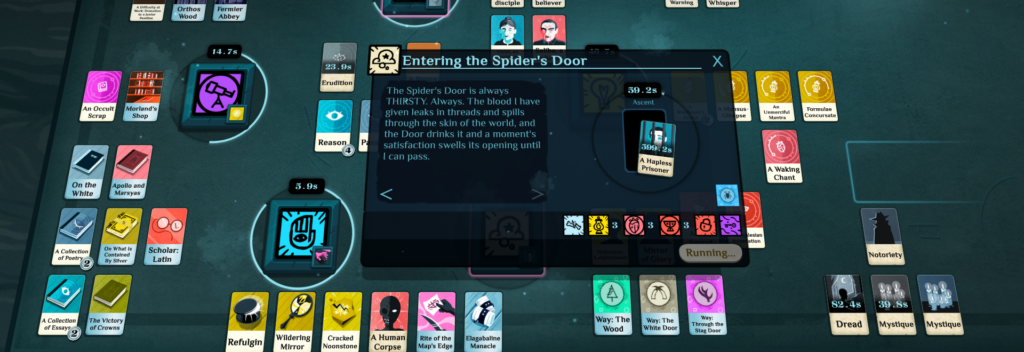
Whatever traits the player has been invited to develop an interest in through the thematic development of the experience. In Sunless Sea the theme of ‘home’ was triangulated by exploration/loneliness/survival, so NPCs were exiles, or defending their home, or looking for a new homeland, etc. I specifically required the other members of the writing team to do this too, and although I didn’t enforce it as well as I should have, it was surprisingly effective. In Cultist Simulator, NPCs were aligned with the Aspects that players were trained to use as a lens or orientation to view the game world (this was so useful I have done something similar in every game since). And so on. If you’ve read any of my other commentary in this are you’ve probably come across the phrase “All the arrows should point in the same direction.”
How to create a character that we want the players to fall in love with? Preferably, right from the beginning of their interactions.
Not my field of expertise, sorry! I think I see the point of it, but I would rather make intentionally contradictory characters that stick in the teeth. Again I realise that companies with larger audiences need to make characters with a broad and immediate appeal, and that companions in CRPGs need to be likable, but as a niche operator this hasn’t been relevant to me. None of the characters in Cultist, Book, Travelling or Sea were intended to be immediately lovable, except for the pets.
Two points though:
- Where I have written characters to fill a companion-like role (in Book and Travelling), I’ve found it useful to have them initially defined by needing something from the player, practically, emotionally or especially implicitly. This immediately engages player sympathy to a surprising degree – like the Benjamin Franklin anecdote about the library book, if you know that one.
- At Failbetter I used to drill the writing team about ‘Harrison Violations’. Harrison Ford famously said to Lucas ‘You can type this shit, George, but you can’t say it.’ Every line out of a character’s mouth should sound like something a person would say. Over-editing and scene requirements often damage that effect. Players aren’t usually consciously aware of it, but it registers and affects their response. Similarly Roger Ebert talked about ‘clangs’ – things that feel out of place or go wrong that gradually affect audience response without them exactly realising it. A character can get away with one or two clangs, but it sabotages player response as damagingly as anything I can think of. As a long standing rule I never put any criticism of another game developer in writing, so I don’t want to give examples, but I find this a useful lens.
Can you share an example of a successful introduction of an antagonist or group of antagonists without justifying their actions and keeping the antagonist evil?
Once again, that’s not something I can usefully answer. As a rule my games haven’t featured antagonists per se, but where they have, an antagonist is just a character with an opposing goal. Players, as players, are usefully angry with characters that oppose them, regardless of the RP aspects. They find ways to demonise NPCs when they are motivated to demonise them, just as they do with other humans. From my point of view, NPCs with justifiable or understandable motives are more effective as antagonists, because then the ‘intentional stance’ inclines us to see them as more real, and the emotional consequence is more arresting.
In the event you played Cultist Simulator through the NG+ / Apostle level, then the rival Long, and especially their endings/final letters, are a good example of what I mean. IIRC, the climactic [REDACTED] I proposed for you folks on [REDACTED] was intended to have a similar effect.
But again, I understand that expectations with large budgets differ and that this isn’t helpful, sorry!
One suggestion: I remember that James Lee Burke writes excellent noir novels with some psychological depth which do include convincingly monstrous villains. I think you might find his techniques useful.


Thoughtful and delightful reading as always, thank you 🙂