
The Player and the Peacock
“The four remaining masks confer, then whip off their faces and turn to the four cardinal directions. Reddish lights glow in the corner of the tent. Every seat in the house is empty.”
Since my last blog post, we’ve started work on Kerisham and Paris, completed Berlin east (one of the weirdest places you’ll go – though the king of weird is still Cracow), completed tracks named things like ‘Breakfast In The Ruins’ and started writing for all the major cities on the map. But seeing as one of the selling points of Travelling At Night is supposed to be travelling around Europe with a fabulously interesting crew of mortals, semi-mortals, immortals and remortals, I thought it’s high time we introduced you to the full troupe. Without further ado, meet the players of the Rosa Mundi circus.
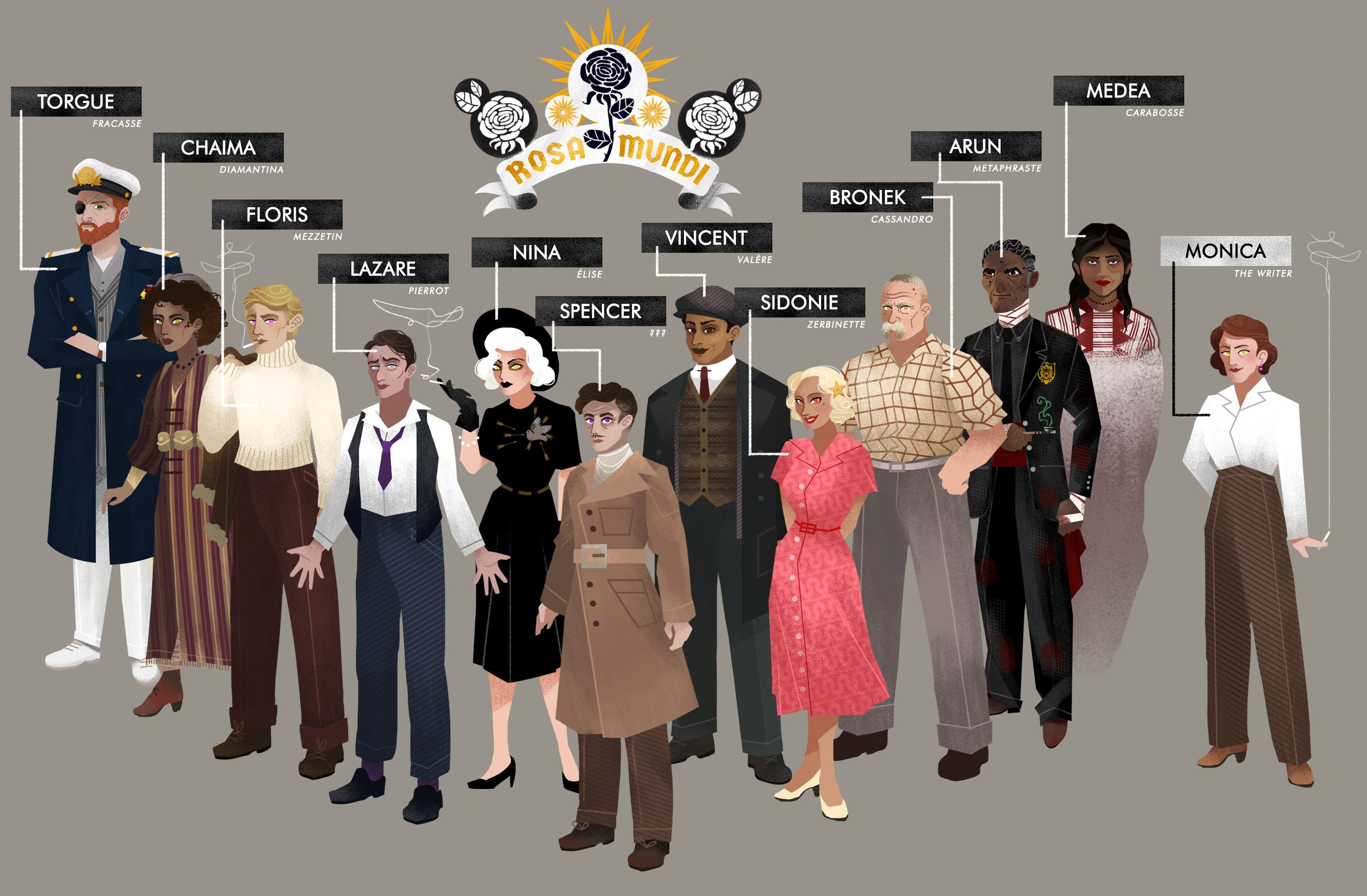
Some of these you know already: Spencer, Chaima, Vincent, etc. I’d like to point out that Medea is not made of candy floss, a victim of Shelob, nor any sort of poltergeist. I just haven’t drawn her in-game persona yet. But I have drawn some new faces: the desperately handsome Floris, caught in a love triangle with Lazare for Sidonie’s affections. The powerful Polish Bronek, who always plays cantankerous old Cassandro with a twinkle in his eye. Wry Monica Medina, the writer, who’s been around the block a few times and all of it was copy. You’ll be able to get to know almost all of these people almost any time you visit the Rosa Mundi, though it’s worth noting that Nina and Medea will never be present at the same time, and you might – if you’re insane – leave Vincent watching Sinombre at the Sanitarium Aujourd’hui and not bring him to the circus at all.
Each member of the circus has a role they usually play. For example, Lazare always plays Pierrot, because he’s a melancholy comic actor; Nina always plays Élise, because she’s hot. AK’s still working on the final design for circus performances, but broadly speaking, they’ll work like this: first, you choose which five-act play to perform. You’ll discover new plays as you travel the world and learn more about the Secret Histories, and not all plays are equal in all places. ‘The King Stag’ is more popular in forest-haunted Mimata, for instance, while the Ministry authorities will see a counter-revolutionary message in ‘The Player and the Peacock’ and won’t let you perform it at all. Some plays you’ll know from Cultist Simulator and BOOK OF HOURS – remember ‘The Queens of the Rivers’? That was one of Monica’s, after all. Others are echoes of commedia dell’arte classics – but distorted echoes. This is the commedia della Sole, a different branch of a familiar tree.
Once you’ve picked your play, you then choose which role you’d like to take on. This is often a strategic choice based on your build of Spencer, as different roles require different skill checks in each act. Succeed and keep making choices as part of an exceptional performance; fail, your performance is merely acceptable, and the play ends without Spencer standing out. Depending on how far you made it through, you’ll receive a combination of cash, Influences and Experiences and Troubles. [AK adds: one design reason for the Performance mechanic was so that in a game without combat, you could grind resources if you backed yourself into a corner after spending everything on fancy tailoring.]
Here’s a concrete example. Let’s say you’ve chosen to perform ‘The Player and the Peacock’. You can either play the scoundrel Scapin or romantic lead Valère, leading to different choices in each act of the play. In Act I as Scapin, you can attempt to steal jewels with Legerdemain or spy on the court using Nyctodromy. If you’re Valère, you can try to Charm the palace inhabitants or use Eloquence to sing a love-song to the Peacock. More choices become available in later acts of the play – but you get the picture.
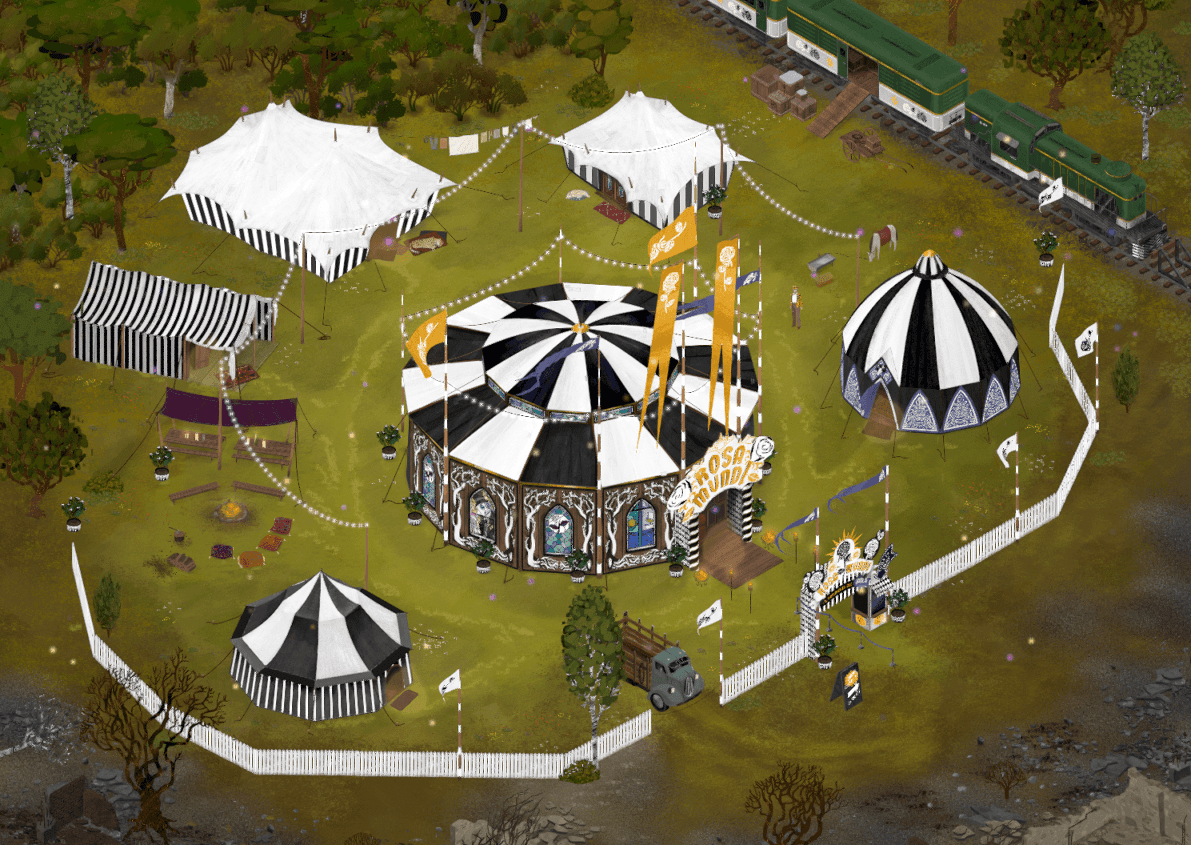
Essentially, we want plays at the Rosa Mundi to be repeatable but variable, with a lot of opportunity for roleplaying along the way. More on this later down the line!
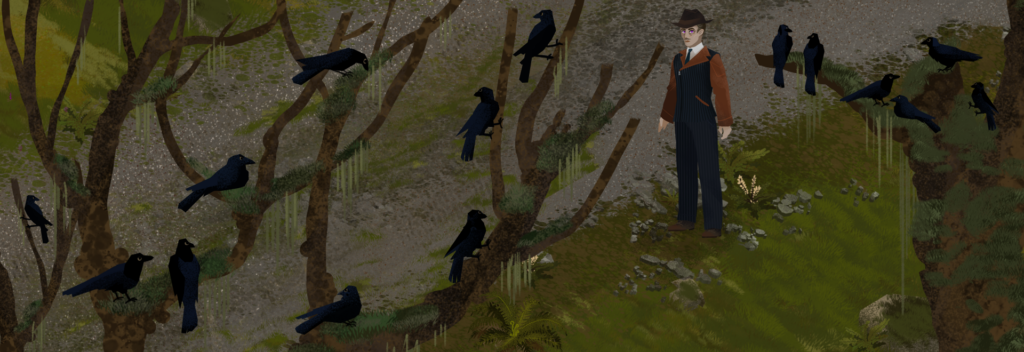
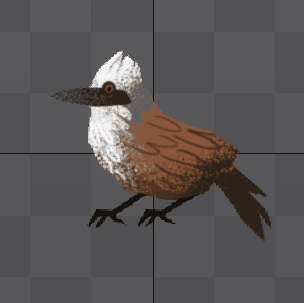
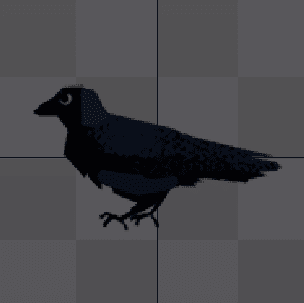
I leave you with the news that while AK has been knee-deep in making the world map functional (including Indiana Jones-style animations when travelling place to place!), I have been doing the much more important work of adding animated BIRBS to the game. Primarily in Mimata, where they cluster furtively along the branches of dead trees, no doubt giving Detective Moore a headache. Are they, like Lovecraft’s wippoorwills,
“…psychopomps lying in wait for the souls of the dying, [who] time their eerie cries in unison with the sufferer’s struggling breath. If they can catch the fleeing soul when it leaves the body, they instantly flutter away chittering in daemonic laughter; but if they fail, they subside gradually into a disappointed silence…”
…or are they your new best friends? Depends how well you speak Birdsong, probably.


I love the idea of a play within a game. Reminds me of Lot 49 – which I only came across when you included it in the CS enigma thing!