
Snapping-up unconsidered trifles
Every few weeks, I see a post on the Weather Factory subreddit along the lines of “[are there] any contemporary or perhaps older (no older than 1800) authors that write in the way this game does.” About as often, I get an email that says something like “I was wondering if this style of writing was perhaps inspired by an author or a series of books you have read”. Years ago I posted this, though it really doesn’t answer the question, because I knew people would keep asking the question.
Why doesn’t it answer the question? Because on that page you will find books by Stoppard and Le Guin and Wolfe and Renault and Chesterton and I could point to something in each of them that influenced my work but I write nothing like any of them. I can’t. I wish I could. But I got a lesson from Chesterton in how to assist the flip between the grand and the prosaic prosodically, from Le Guin in how to shift perspectives between sentences without announcing the shift, from Wolfe on how you can put a secret in plain sight and never make it explicit but still let the reader enjoy it later as a revelation.
There was a semi-fib in that last paragraph. I said ‘I wish I could [write like them]’. I don’t. I’d like to be able to write as well as them, but I would be doomed if I could replicate their style. Hemingway: “What a writer in our time has to do is write what hasn’t been written before or beat dead men at what they have done”. Good luck beating the best if you’re not Hemingway.
We read someone to whose work we respond, and then of course we want to extend that experience into our own work. The trap: if we look at the grand sweep of what they’re doing and try to write that feeling, it’s mimicry, not inspiration. So we gots to take it apart. Sorry. At least we don’t have to vivisect it. ‘Taking it apart’ often just means reading two very different writers side by side and noticing the differences. Very little good writing is done on an assembly line by principle. Leave the disassembly to the academics, who are paid, in general, even worse than the writers.
There are three reasons that I always decline occasional bits of consultancy work offered by bigger companies. One is that I don’t enjoy it. Another is that I genuinely don’t think my advice is at all useful to people not in my extremely specific line of work (good luck preaching to a jobbing CRPG writer on a hard deadline that they should ‘read more Simic’.) A third is that all the trade secrets of a writer are largely out there in the prose for anyone to look at. It’s the words, guys. We’re all of us open source already.
And there are three reasons why writers don’t like being asked “Where do you get your ideas?” The first is fear of claim-jumpers. The second is that writers love to complain, and this is an authorised opportunity to complain. But the third is that it misunderstands the process. You get an idea because you look out of the window and see a grumpy pigeon at the necessary moment. The pigeon then serves as a moment of bathetic punctuation when your character stares out of the window in a moment of desperation and meets the eyes of a grumpy pigeon. That doesn’t mean you should get your ideas from pigeons.
So –“if this style of writing was perhaps inspired by an author or a series of books you have read…” – all of ’em. Here are seven examples of my work with their specific inspirations. The point being, anyone else who leant on these things for inspiration would write something completely else.
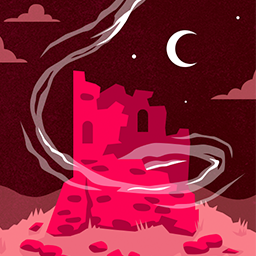
1. Cultist Simulator, Tower Revek: “The blasted stump of a building. The air festers. Whatever power destroyed this place still clings.”
Thank you, Douglas Adams, for the opening of Dirk Gently’s Holistic Detective Agency: “t was a blackened stump of a tower. It stood like an extrusion of magma from one of the more pestilential pits of hell, and it leaned at a peculiar angle, as if to look down more contemptuously on the gray plain below.” There’s nothing at all in there in common except the word ‘stump’, but the image was vivid enough to surface years later when I was casting around for the twentieth idea for yet another Vault.

2. Cultist Simulator, the Stag Door: “Our company it was that shattered it,’ Ghirbi says suddenly -“
Thank you, Giambattista Marino, for La strage degli innocenti, or rather, because I don’t read Italian, for Erik Butler’s translation:
“We fought against the empire of heaven. We were – that I will not deny – vanquished in that conflict: yet the great intention was not lacking in nobility. Something or other gave them victory; to us remains the glory of a dauntless daring. And even if my troop fell thence vanquished, yet to have attempted a lofty enterprise is still a trophy.”
Satan, obv. Again, the only actual direct similarity at all is ‘my troop’ for ‘our company’ – and obviously the grandeur of the Fall wasn’t a new story. But I hadn’t run across this sense of Satan as a regretful old soldier. So it caught my ear and you got the shattered bronze face.
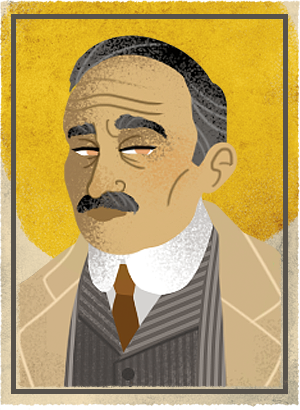
3. Travelling at Night, Douglas Moore: “Et by Worms, as I recall. And then there were those murders. But the victims weren’t right either, and anyway it was on the Continent, so we didn’t overly trouble ourselves. “
The thing about writing Douglas (no relation) is that it’s easy for him just to sound pompous, and I want the dry twang of the lower-middle-class mid-century London detective. So whenever a line sounds too prissy (that one was originally “the victims weren’t exactly human”) I close my eyes and think of Philip Jackson as Japp in the Suchet Poirot. As a star to steer by, not an authority! Japp on TV is not as tersely written as the Christie Japp, and neither TV nor Christie Japp would ever opine “It is, as Mrs Moore would say, something of a leitmotif, the old nuns. She likes a bit of opera, does the Mrs.” But he helps D.O. Moore not to sound accidentally like Lord Peter Wimsey, does old Japp.

4. Travelling at Night, Monica Medina: “Astorre is tupping some shepherdess in a barn, Sidonie. Oh, take that look off your face. You know what he is. If Asto wants to keep the mask, he needs to keep his trousers on.”
There are sixteen seasons of Ed Reardon’s Week and I’ve listened to all of them twice. Again, Monica doesn’t sound like Ed Reardon, again, I’m not nearly as funny as Christopher Douglas (no relation either) and Andrew Nickolds (RIP), but the perpetual Rainham Volcano smoulder of Ed’s resentment fired Monica’s ire.

5. Cultist Simulator, Miah and the Orchard of Lights: “There was a city here. We can pick over its remains like jackals over old bones: palace walls, buried roads, shattered fountains.”
This is another pigeon. I needed a twenty-first Vault in Cultist Simulator and I remembered the ruined city in the desert in the last act of Clive Barker’s Weaveworld. I could have remembered any of two dozen other ruined desert cities, and in any case (I only remembered later) it isn’t even a ruined city in the desert in Weaveworld, it’s something more interesting. Likewise, the Orchard of Lemuel Lo inspired the Orchard of Lights, and has nothing in common at all except it’s (a) nice (b) an orchard. But it happened to be Barker. Not entirely a pigeon, I suppose; he gets in your basements, that Barker.
(“Like jackals over old bones” – the problem with reading your writing from ten years ago is you see the mistakes. Jackals don’t pick over old bones, and if they do it’s a cliché. There was a better simile in there somewhere if I’d’ve dug harder.)

6. Book of Hours, Valentine Dewulf: “Each winter the black-backed gulls would leave Brancrug for warmer climes. Valentine would command a candle-lit dinner on the beach in their honour, with dancing and drumming, though he would never attend, only watch approvingly from the Gullscry Tower.”
Labyrinthine palimpsest-castle, the lonely tower, the melancholy aristocrat, the absurd ceremonies, the tragic death: these are the ‘only’ things that Valentine Dewulf, sixth Baron of Brancrug, had in common with Sepulchrave Groan, seventy-sixth Earl of Gormenghast. Valentine wasn’t a foreground character, he wasn’t married to a lady full of cats, his library wasn’t burnt down, he wasn’t eaten by owls. But there’s the inspiration.

7. Cultist Simulator, Contentment: “Some days are better than others. Sometimes the sky is nothing like a filthy sheet. Sometimes the river runs clear.”
Once again, no visible inheritance, nothing you could call an inspiration except that it actually happened to be something that stuck in my fifteen-year-old mind like a poacher’s dart – at the end of the Dirk Gently chapter whose beginning you just read, this insouciant boomerang pounce:
“…an altogether livelier day than any yet known. A clear river ran through the shattered remains of the valley. And time began seriously to pass.”


Really interesting to see how these snippets have been blurred and reflected in your work. I've never read/watched/played anything like Weatherfactory's games, though there are some things that have given me a similar feeling (Piranesi, A Dark Room, Dogsbody -- which I think I remember reading inspired the stars in FL), Something Wicked this Way Comes, and The Deptford Mice trilogy and its old god-like cat). I enjoyed the Skeleton Songs episode where you talked about making horrible but entertaining characters -- out of curiosity, is there anything you drew from when writing Hokobald?