
The Alley of Dangerous Angles
“The truth, however ugly in itself, is always curious and beautiful to seekers after it.”
— Agatha Christie, The Murder of Roger Ackroyd
The year is cold and new and stiff, so I have been cocooning myself indoors, not doing the marketing I should, and wrapping myself in a blanket of art. This has involved lots of sulking as I have had to learn how to animate flags.
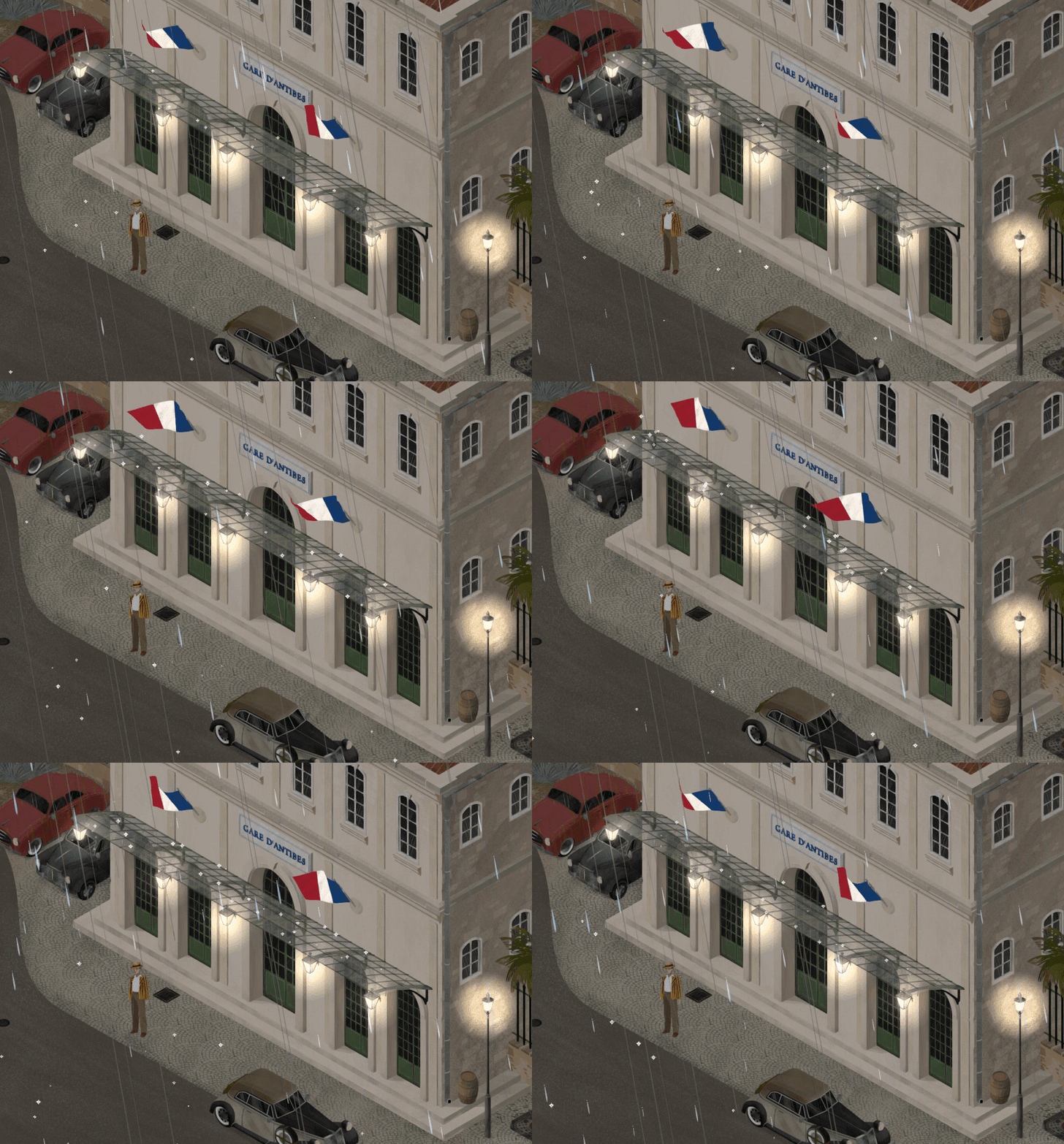
Gare d’Antibes is one of the first places you see when you start a new game, and I’m happy with how it’s shaping up. But I’ve also been working on what AK and I are calling cutaways: small, perfectly-formed interior locations you can enter from external locations without loading screens. The idea behind them is to fill our large cities to the brim with interactables, semi-hidden locations and points of interest. Anyone who played the pre-alpha over Christmas – focused entirely on a large internal scene, the Sanitarium Aujourd’hui – will know the effect we’re going for.
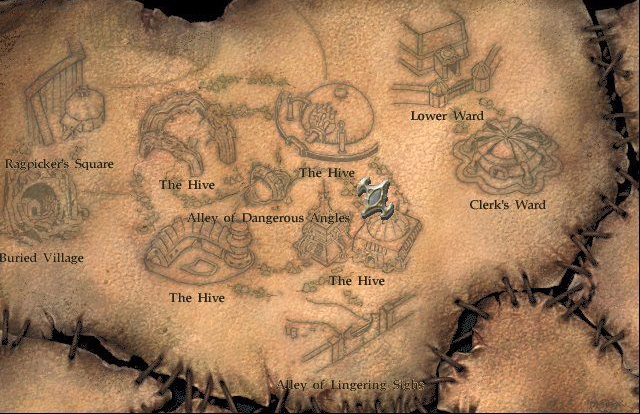
As players, AK and I are both big fans of Planescape: Torment. As devs, it taught us to beware what we call the ‘Curst curse’. Most of Torment takes place in the city of Sigil, a giant city of doors. It’s divided into different areas each full to the brim with characters, companions and quests. If you’re not paying attention you can even get on the wrong side of a giant floating demigod called the Lady of Pain who ‘mazes’ you to an ‘almost inescapable pocket universe in the Ethereal Plane’. I did. I reloaded. But I digress. Here’s your map, to give you a sense of how large Sigil is:
However, around two-thirds of the way through Torment you leave Sigil and journey to a new city called Curst. Initially it’s exciting to be in a totally different place with new characters and a new vibe, but it becomes apparent fairly quickly that Curst feels flat, not deep. It doesn’t have the amount of interactions, storylines or interest that Sigil does. This is mostly Sigil’s fault, just for being so well made. It’s a tough act to follow for Curst. I believe it’s also the fault of late-stage production cuts, meaning the devs couldn’t fit in all the stuff they presumably wanted to. I bet you can think of other CRPGs that seem fatter at the start and thinner at the end besides Torment. All games suffer the tyranny of the iron triangle. But we’re trying to minimise this in Travelling At Night by planning out a roughly even amount of interactivity across all our major scenes, so you don’t travel from Caen to Mahaggony and think, pfft, did the devs just head off to the pub for this one? CRPGs are a famously content-hungry genre, after all. Games academic Espen Aarseth calls them MSGs (‘massively singleplayer games’), for instance – a coinage that haunts me with its accuracy.
I’ve talked before about the feeling of some expensive, well-made RPGs feeling like they have a layer of plastic over their environments. They initially look vast, full and fascinating, but pretty quickly you realise you can only interact with certain points marked by UI elements, and the majority of the world you’re running about in is window-dressing. Again, this is not to neg on other games – it’s just the effect of production realities, which I’d like to avoid in my own games. Which leads us back to cutaways, one of the several different approaches we’re taking to puncture the plastic of the Secret Histories. We’re two people plus freelancers: we just can’t make every building in every city across Europe a place you can go in and explore. But we can dot a number of thoughtfully-placed interactable experiences across a landscape. Sometimes it’ll be a single snippet of text, describing something you see; sometimes a full-on portal to a new scene. Or sometimes it will be a cutaway, where the lights dim, the camera focuses, and you enter a semi-hidden inside space like a cat finding a nook behind the sofa.
Take Antibes’ Librairie des Heures, for example. I have a particular soft spot for this interior, partly because a crammed, old-school book shop is always attractive, but also because it’s a nice syncretism between Adrien’s art and my own. I took Adrien’s exterior (he drew all of the outside of Antibes) and used it as a basis for painting the interior (plus some period-appropriate periodicals, newspapers and film posters). Here’s the bookshop when it’s freshly painted in Photoshop:
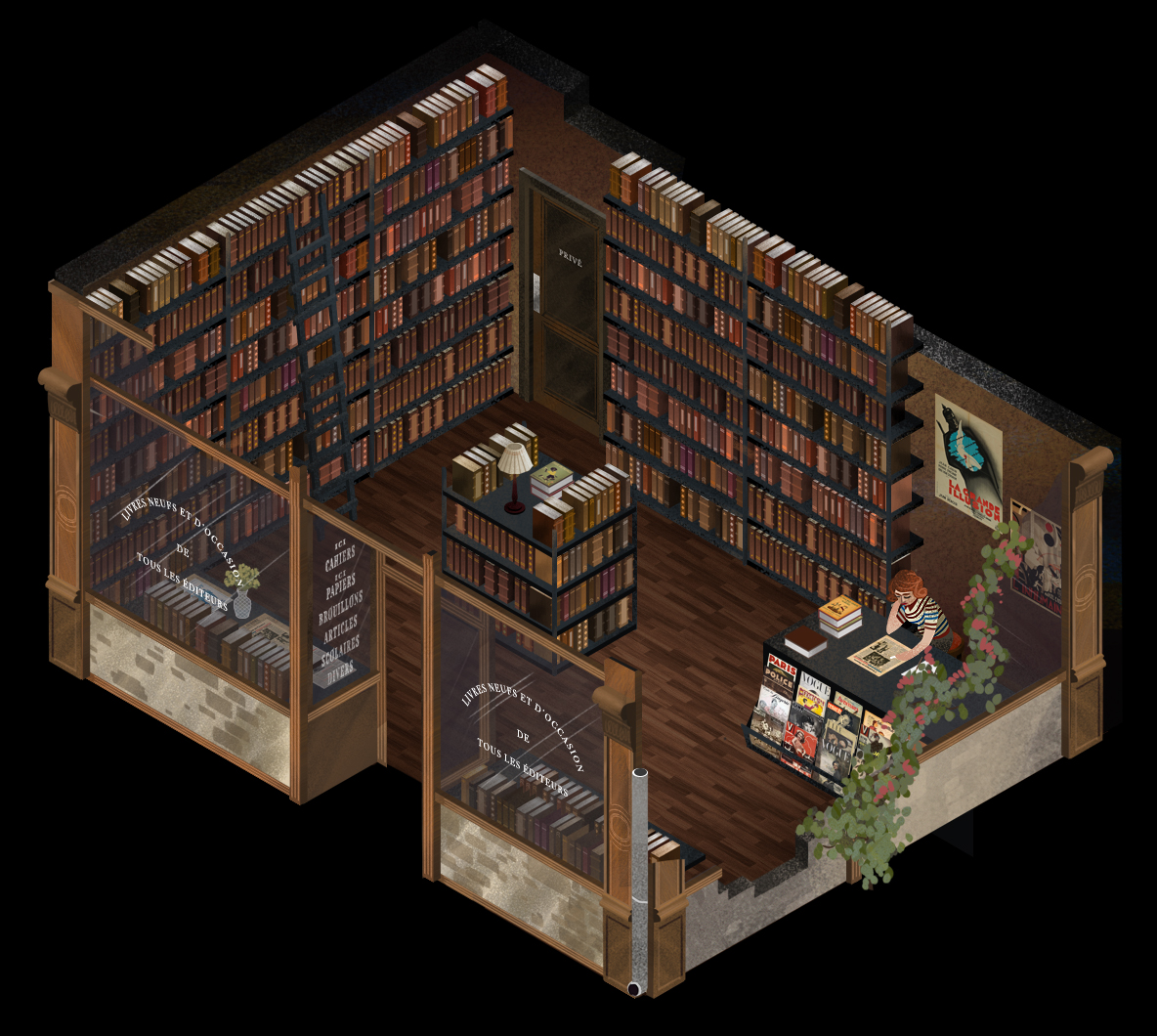
Pretty cute, huh? But look at it when it’s been set up properly for the game:
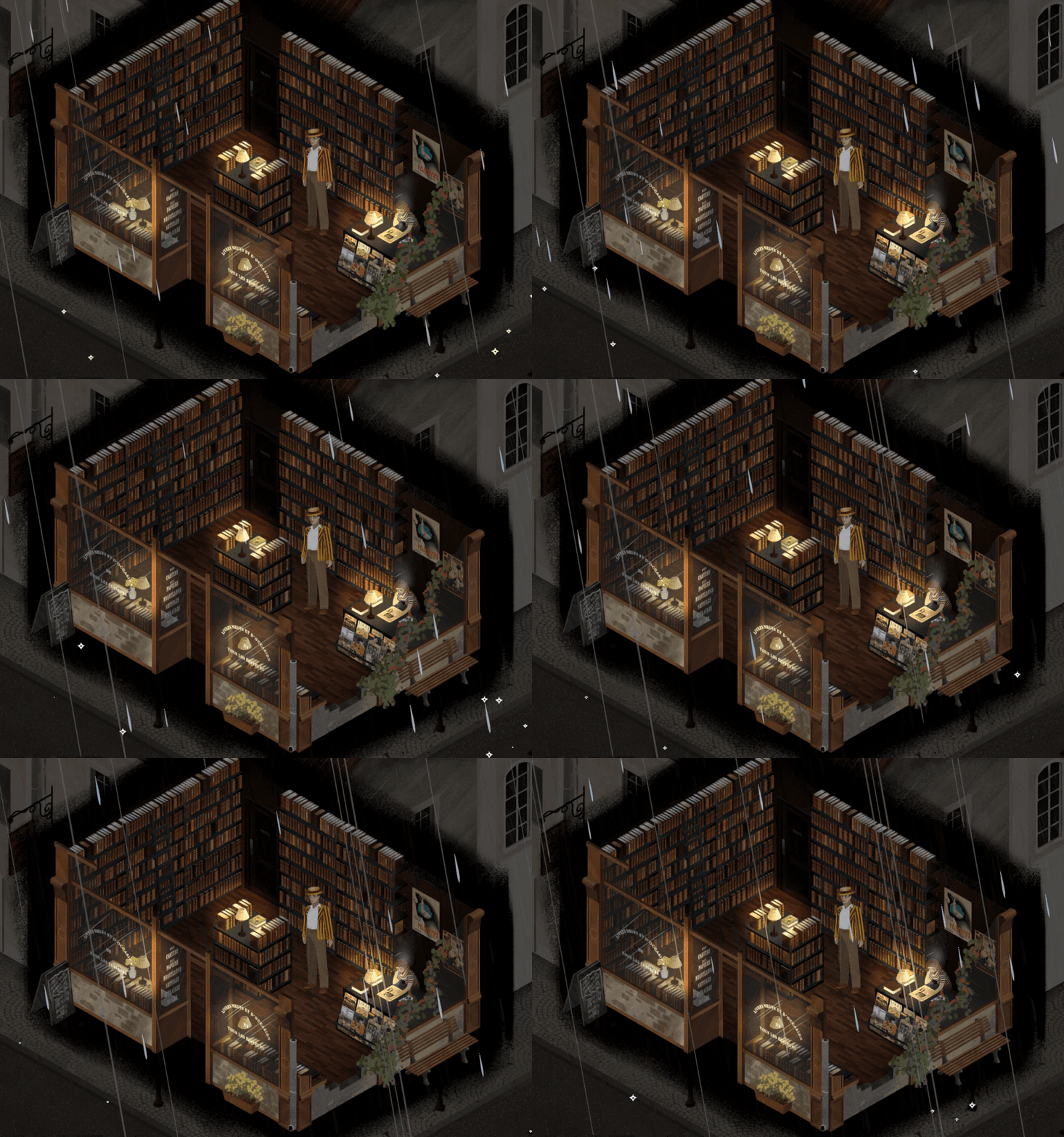
Like Victor Frankenstein, we have now infused life into an inanimate body! This version of the librairie has been cut up into the necessary pieces* for Unity to know what should display in front of or behind of a moving player character, giving our depth to our totally 2D art. It’s also been lit, with accented glowies on the lamps, while a separate animated rainstorm plays over the exterior (western Antibes is eternally rained upon, for reasons that will become apparent when you play the game). It creates – I hope – a sense of being cozily tucked away from the outside world, like the scene-setting of BOOK OF HOURS: “Shutter the windows against the sea. Bank the fire against the cold. Listen to the rain rattle on the roof…”
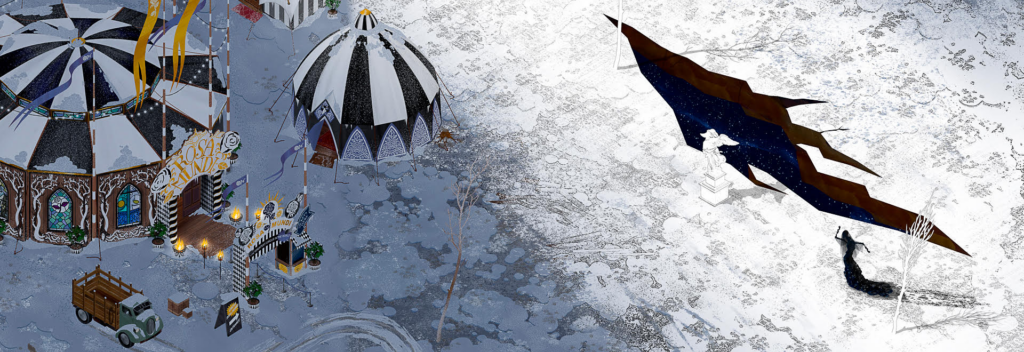
A large part of this year will be spent Frankensteining, infusing what life I can into our myth-scarred 1940s world. But just to return to the true weird of games like Torment, Travelling is not all book-nooks and tea. The Mansus is not a kind place. The second world war did not make it kinder. And even BOOK OF HOURS had an oubliette in its cellar. So I thought you might appreciate a hellish amuse-bouche of what’s to come. With no explanation, here’s a location from East Berlin:
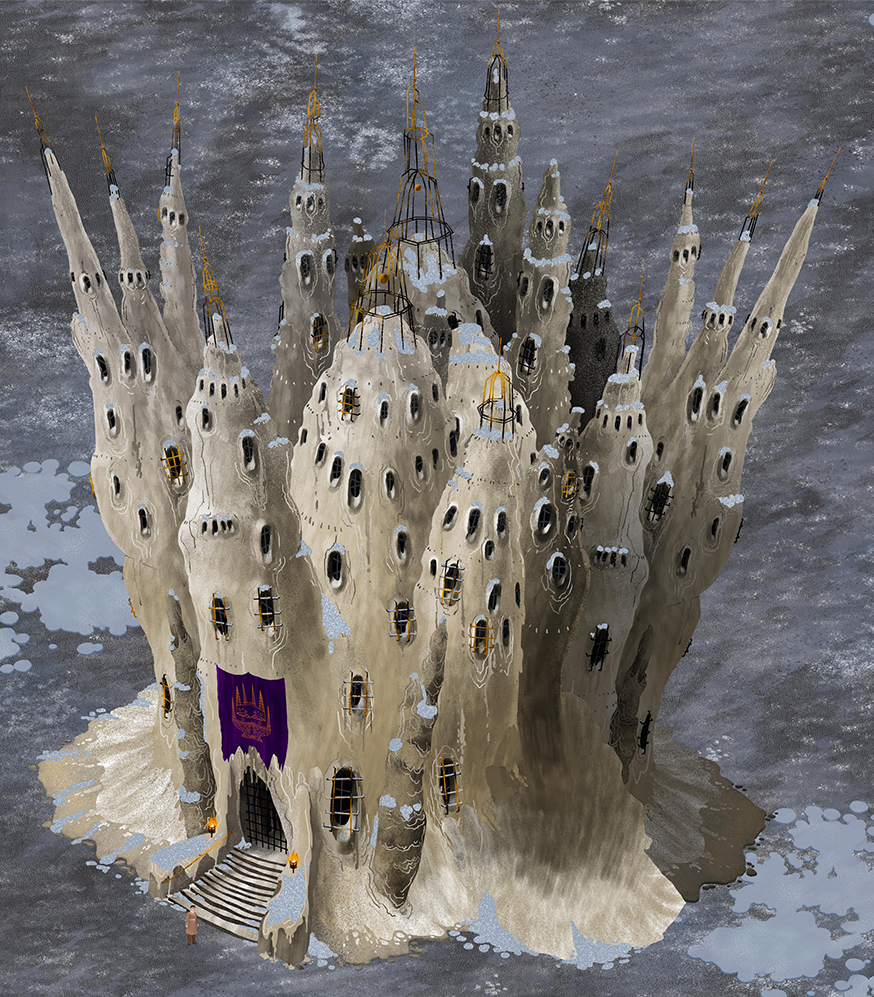
Any guesses what it might be?
*This means I have assets with names like ‘front wall left behind 2 right’ and ‘lid bookshop 2 FIXED’. This makes me a professional.


I’d like to spend several hours looking through that bookshop.
The pale trypophobic spires are slightly less cozy, but I’m very curious about them
The art direction for Travelling is really shaping up! Love these environments 🙂
The East Berlin location is giving me horrible termite mound, so I can only guess that it houses horrible termites.